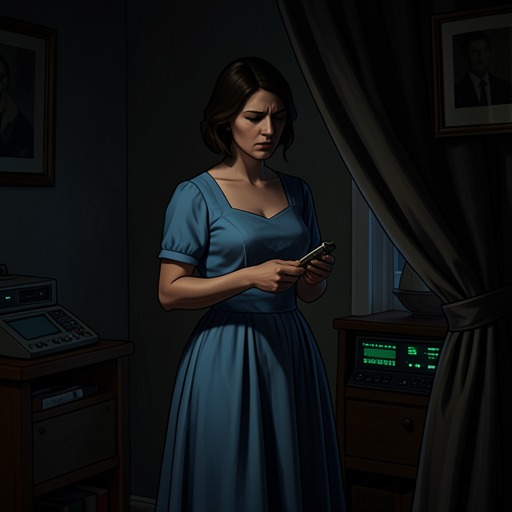
Delilah Sheridan
Box Set: Samsons Sterbliche Geliebte & Samson's Lovely Mortal (Deutsch·Englisch) (Scanguards Vampire) (German Edition)Delilah Sheridan is the human protagonist whose forensic-accounting assignment at Scanguards becomes the entry point into the novel’s concealed vampire society. Arriving in San Francisco on her first business trip there, she brings an outsider’s professional authority to a company whose respectable surface hides financial betrayal and supernatural secrets. Her decisive significance lies in the way she refuses to remain merely a victim of danger or a passive recipient of Samson Woodford’s protection: she follows evidence, tests appearances, survives attacks, confronts the truth about vampires, and ultimately chooses intimacy with full knowledge of what Samson is.
Identity and Professional Background
Delilah normally works as an independent consultant conducting special audits along the East Coast, and her San Francisco assignment is an unusual departure from that established route. Her specialty is forensic accounting, a field she regards as the most exciting branch of accounting because it allows her to uncover concealed wrongdoing rather than simply review ordinary transactions. The work also gives her a comfortable standard of living and, crucially, control over her own schedule.
Her professional identity is defined by persistence and evidentiary discipline. She continues scanning rows of transactions even when her eyes ache and her neck stiffens, longing for a massage or a brief soak in a hot tub but recognizing that neither will happen that night. Later, after sleeping long enough to recover, she plans to work extra hours to compensate for lost time. These details establish her as someone who treats exhaustion as an inconvenience to manage rather than a reason to abandon an investigation.
Delilah’s assignment is not a routine audit. She explains that she handles special investigations and can detect falsified books, and that she has already found indications that someone is defrauding the company. Her immediate objective is to confirm who is responsible. When John Reardon resists her requests, she contains her irritation and continues working; his hostility does not displace the authority granted by her instructions. She therefore enters Scanguards not as an inquisitive trespasser but as an authorized specialist whose methods make the company’s hidden structure vulnerable to exposure.
Entry into Samson’s World
Delilah’s first business trip quickly becomes a crisis of survival. After being attacked, she recognizes the assailant when she encounters him again and identifies him as the same man who attacked her the previous night. Her response is practical rather than helpless. She remembers the principle that an attacker must never be allowed to move a victim to a second location, because remaining where passersby might notice offers the best chance of escape. This survival training guides her decisions even when fear and confusion are overwhelming.
During the rain-soaked pursuit, Delilah finds herself on an unfamiliar side street, her clothes already soaked and the approaching man clearly offering no help. She spots a row of Victorian residences, most dark except for one whose illuminated front room seems strangely familiar. Treating it as perhaps her only opportunity, she crosses the narrow street, runs up the steps, and pounds on the door. The house becomes both refuge and threshold: it saves her from the immediate attack while bringing her into Samson’s private environment, where the ordinary rules she knows begin to fail.
Her first contact with Samson is marked by uncertainty and suspicion. She confirms her name, wondering whether she has correctly understood the name others used for her rescuer: Samson. She notices that his hazel eyes follow her movements even when he says little. His formal written apology for the previous night and invitation to accompany him to the theater offer a conventional social script, but the circumstances surrounding it are anything but conventional. Samson remains awake after daylight because he is waiting to learn whether she has accepted the invitation, while Delilah is still trying to determine whether the man who rescued her is safe.
The theater invitation also reveals the instability of Samson’s public persona. He presents himself as a polished gentleman capable of arranging an evening out, with Oliver waiting downstairs for her answer, yet his behavior and limitations continually expose something concealed. Delilah notices that he cannot simply appear with her during the day. The discrepancy between the respectable employer and the inexplicable man becomes central to her developing suspicion.
Investigation and Encounters with Scanguards
Delilah’s audit gives her a concrete route into the company’s internal conflicts. She works late under John’s supervision because he insists on remaining at the offices while she is there, apparently unwilling to leave an auditor alone with access to the books. His distrust proves accurate in one narrow sense: Delilah is actively examining records, but she is doing so under explicit authorization and with a precise investigative mandate. Her attention to irregular transactions turns suspicion into a methodical search for the buried source of the problem.
She continues to assert this professional position even as personal and supernatural dangers multiply. At Scanguards, she identifies herself as an auditor and later learns that Milo is an accountant within the company. That information matters because it connects a seemingly administrative role to the wider financial conspiracy. Delilah does not abandon the audit after her life is disrupted; instead, she seeks the return of ordinary structure through work. When Samson offers to discuss the audit, she regards the subject as a possible restoration of normality amid a life that has been shattered by revelations and violence.
Her investigative thinking extends to technology and accountability. Delilah asks whether the computer system tracks which login has accessed particular files, recognizing that access records can connect suspicious activity to an individual rather than leaving wrongdoing at the level of vague irregularity. This question exemplifies her wider method: she looks for a traceable chain linking anomalous transactions, authorized access, and responsibility. The audit is thus not background decoration but the procedural intelligence through which she challenges Scanguards’s surface order.
Delilah’s independence also creates friction with men who expect compliance. She is irritated by John’s reluctance to cooperate, yet she does not allow his unfriendly behavior to deter her from logging into the available desktop computer. At the same time, her interactions with Samson expose another kind of pressure. He can interpret her confidence as evidence that she has him under her influence, but Delilah internally rejects the idea that she is a seductress who manipulates men. Her self-conception is grounded in professional competence rather than calculated erotic power, even though the relationship repeatedly places her inside romantic and sexual expectations she did not initially choose.
Witness to the Vampire Secret
The decisive rupture occurs when Delilah sees Samson’s eyes turn red. She first notices the change when he shouts at Ricky, where it appears as a startling alarm-like flash against the familiar hazel color. The transformation shocks her more than Ricky’s sudden arrival because it cannot be explained by ordinary emotion or lighting. When Samson’s eyes later become vividly red again, the visual clue is no longer an isolated anomaly but evidence demanding interpretation.
The discovery becomes comprehensive when Delilah connects several previously disconnected details. She understands why Samson has no bathroom mirror and reasons that, if vampires have no reflections, he would have no practical reason to own one. She also reinterprets his inability to spend the day with her: as a genuine vampire, he cannot face sunlight without being reduced to ash. What had appeared to be eccentricity, absence, or controlled secrecy is reorganized into a coherent supernatural identity.
Her reaction is physical and immediate. She screams, retreats while gripping the counter, and later asks what Samson is while struggling to breathe. The repeated image of the red eyes marks the collapse of his disguise and the failure of the socially acceptable identity he has maintained around her. Yet the revelation does not end her connection with him. Instead, it forces a renegotiation: Delilah must decide whether the man she desired and trusted can still be recognized within the predator whose existence he concealed.
This knowledge also changes her relationship to the Scanguards network. Gabriel Giles, who runs the New York headquarters, is introduced to her as one of their kind, confirming that Samson’s condition is not an isolated personal aberration. The organization possesses a broader supernatural membership and structure. Delilah therefore moves from suspecting one inexplicable man to confronting an entire hidden community whose members operate through ordinary businesses, professional roles, and systems of secrecy.
Blood, Memory, and Chosen Attachment
Delilah’s relationship with Samson combines attraction, fear, distrust, and deliberate return. After the supernatural revelation, she still seeks a way to discuss the audit and recover some intelligible ground. Her willingness to remain engaged does not erase the danger; it shows that she is attempting to hold two truths together, namely that Samson has deceived her and that her attachment to him is genuine.
Her emotional history is also concentrated in the meadow near a small village in France. She explains that the meadow is connected to the only good memories left from her childhood with her baby brother before an unthinkable event occurred. Because nobody is supposed to know what the meadow means to her, Samson’s apparent knowledge of it threatens the privacy of her past and raises the possibility that his investigation into her identity has reached places she considered inaccessible. The meadow consequently functions as more than a setting: it is a protected memory, a measure of trust, and a test of whether intimacy can coexist with surveillance.
Delilah’s bodily choices become increasingly consequential. When Samson needs blood, she offers her own without hesitation and pushes up her sweater sleeve. The act is not presented as an automatic surrender to his appetite; it is her active decision to place her body and life within a supernatural exchange. Samson’s fangs enter her wrist, and the immediate pain fades as he drinks with his eyes closed. The scene transforms blood from a vampire’s means of survival into a medium of reciprocal attachment and danger.
Her later explanation makes the motivation explicit. Delilah says that she did not save Samson because of abstract duty or because she was indifferent to the consequences. When he lay dying, she could not imagine living without him, so she gave him her blood because she wanted him and still wanted him. This confession rejects the notion that she is merely being controlled or carried along by Samson’s world. She claims responsibility for the decision, even while acknowledging its selfishness and emotional cost.
The final gesture intensifies that agency. When Delilah exposes her neck and tells Samson to bite her, she converts the vampire’s predatory act into a requested act of intimacy. The gesture does not make the danger disappear, but it changes its meaning: Samson is no longer the only person determining the terms of contact. Delilah’s consent, spoken after fear, suspicion, and revelation, becomes the condition under which their bond can continue.
Narrative Role and Transformation
Delilah begins as a highly capable professional who enters San Francisco to locate financial fraud and finds herself forced to investigate an even more radical hidden reality. Her movement through the plot is therefore double. As an auditor, she traces irregularities through records, suspicious access, and company personnel; as a survivor and intimate witness, she traces the inconsistencies in Samson’s body, schedule, home, and public identity. Both forms of inquiry demand that she refuse the first available explanation.
The contrast between her professional expertise and the romantic danger around her gives the character her distinctive force. She can be treated as a woman in need of protection, but she also knows how to prevent an attacker from taking her to a second location, how to confront an uncooperative client, and how to ask the technological question that may identify unauthorized access. She can be desired as a romantic partner, but she also determines when to offer blood, what truths to demand, and whether to expose her neck.
By the end of the supplied arc, Delilah has not returned to the uncomplicated world from which she came. She has learned that Scanguards contains vampires, that Samson’s apparent normality is a carefully managed appearance, and that the relationship she wants is inseparable from supernatural bodily risk and concealed social structures. Nevertheless, her response is neither simple denial nor passive submission. She continues to work, investigate, remember, challenge, and choose. Her transformation is the novel’s passage from misrecognition to negotiated knowledge: she becomes capable of loving Samson not because the secret is removed, but because she has confronted it and still claims a voice in what follows.